On the morning of July 10, 2026, the School of Artificial Intelligence successfully hosted a GPNU 70th Anniversary Distinguished Lecture by Professor Marius Pesavento from the Technical University of Darmstadt (TU Darmstadt), Germany. The lecture took place from 10:00 a.m. to 11:15 a.m. in Room 409 of the Industrial Center on the East Campus. The event was chaired by Professor Yongwei Huang. Professor Yongjin Lin, Associate Dean of the School of Artificial Intelligence, attended the lecture together with numerous faculty members and students from School of Artificial Intelligence and other engineering Schools.
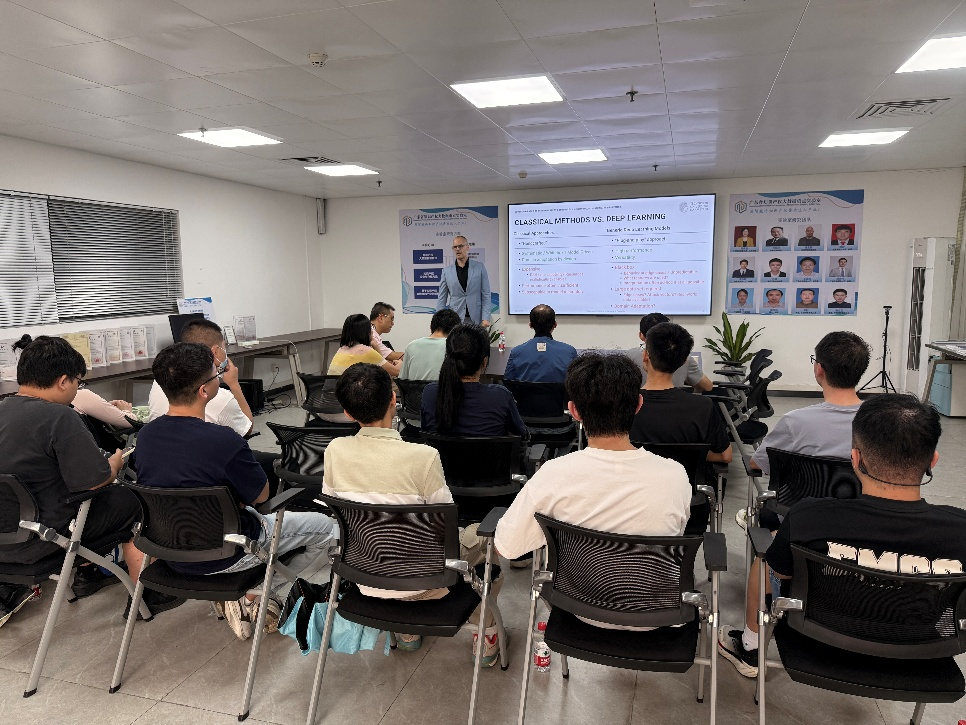
Professor Pesavento delivered a lecture entitled "Model-Driven Deep Learning for Codebook-Based Downlink Beamforming under Incomplete Channel State Information." Focusing on recent advances in model-driven deep learning, he first analyzed the limitations of conventional optimization algorithms and generic deep learning models for beamforming design. He then introduced a novel model-assisted deep learning framework that integrates iterative optimization algorithms with graph neural networks. Through extensive numerical experiments, he demonstrated that the proposed framework achieves significant improvements in power efficiency, computational complexity, and generalization capability compared with existing approaches.
Professor Pesavento is an internationally renowned expert in signal processing and MIMO communications. He serves in leading editorial and professional roles within the IEEE community and has made outstanding contributions to the fields of statistical signal processing, wireless communications, and optimization.
The lecture concluded with an engaging question-and-answer session. Faculty members and young researchers actively exchanged ideas with Professor Pesavento, raising insightful questions on topics including beamforming, channel estimation, and the practical deployment of intelligent algorithms. Professor Pesavento addressed each question with detailed explanations, fostering lively academic discussion and interaction.
This distinguished international lecture provided an excellent platform for high-level academic exchange, broadened the international research perspectives of faculty members and students, and offered new insights into interdisciplinary research at the intersection of wireless communications and artificial intelligence. The event further promoted the School's academic innovation and strengthened its international collaborations.

